
Buying and Selling
Buying a Home in Missouri: How to Compare Different Communities
By Amanda Greenwood ·


Buying a Home in Missouri: What Buyers Should Know When Comparing Different Communities
Buying a home in Missouri can look very different depending on which community you are considering. A home near Fort Leonard Wood may need to be evaluated differently than a lake property at Lake of the Ozarks. A home in Lebanon may come with different utility, commute, and resale considerations than a home near Springfield or Branson.
That does not mean one community is automatically better than another. It means buyers need to compare more than the house itself.
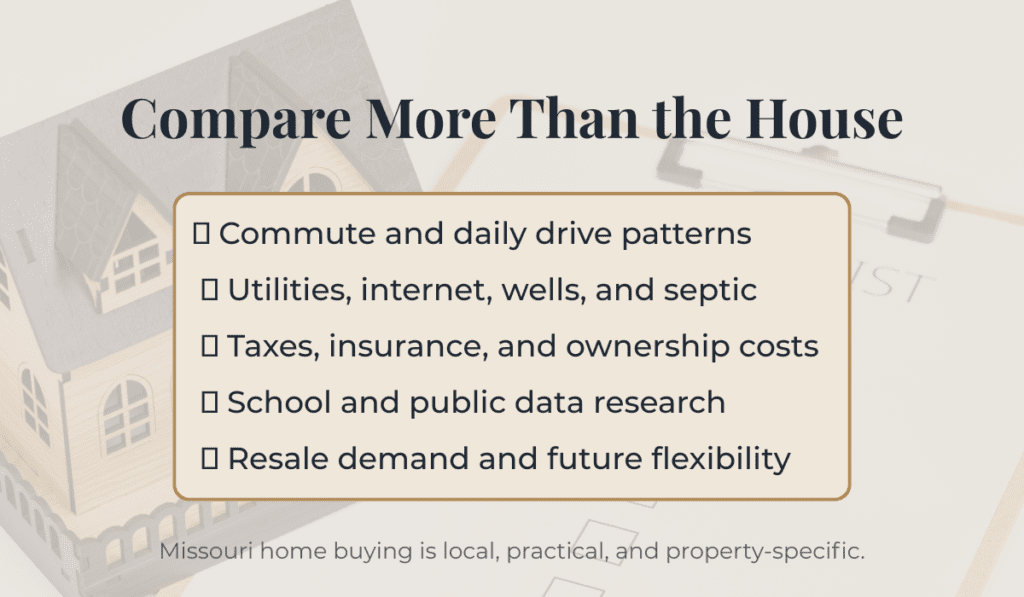
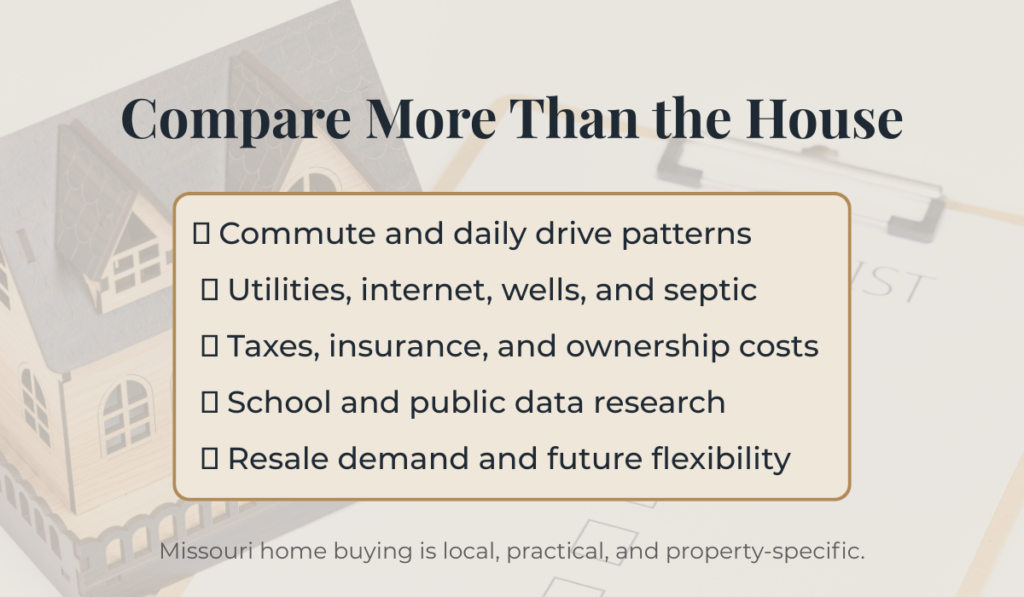
The monthly payment matters. The floor plan matters. The condition matters. But when you are comparing homes across different Missouri communities, you also need to look at commute patterns, utilities, internet availability, property taxes, school information, flood risk, inspection items, resale demand, and how the area fits your actual life.
Missouri can be an affordable state compared with many parts of the country. The Missouri Economic Research and Information Center reported that Missouri tied for the seventh lowest cost of living in the United States for the first quarter of 2026. But affordability can still look very different from one local market to another, especially when you compare lake communities, military relocation markets, rural acreage, small towns, and larger metro areas.
This is why a good home search should not be just “Which house do I like best?” It should also be “Which community, cost structure, and resale path make the most sense for me?”
Helpful resource: Missouri cost of living data
In This Missouri Home Buying Guide
What changes when you compare homes across different Missouri communities
Why commute and daily drive patterns matter
How utilities, wells, septic, and internet can change the real cost
Why school research should come from official sources
How flood risk and insurance can affect the decision
Why resale demand is not the same in every Missouri market
How to compare lifestyle without violating Fair Housing rules
What to ask before choosing between two similar homes
Comparing Missouri Communities Starts With How You Actually Live
When buyers compare homes across Missouri communities, it is tempting to compare only price, square footage, bedrooms, bathrooms, and finishes. Those details matter, but they do not tell the whole story.
A buyer moving to the Fort Leonard Wood area may care heavily about commute time to post, PCS timelines, rental backup options, and resale demand from future relocating buyers. A Lake of the Ozarks buyer may be comparing waterfront, lake access, dock permits, cove location, nightly rental rules, insurance considerations, and seasonal demand. A buyer looking near Springfield, Branson, Lebanon, or smaller Central Missouri communities may be comparing daily drive patterns, local services, healthcare access, internet availability, and how much maintenance comes with the property.
The better question is not “Which community is best?” The better question is “Which community fits the way I need the home to function?”
That keeps the conversation practical, personal, and compliant. It also helps buyers avoid making a decision based only on what looks good online.
Commute Can Change the Value of Two Similar Homes
Two homes can look almost identical online but function very differently once you add real-life drive time.
In Missouri, commute and road patterns matter because many buyers are comparing small towns, rural properties, lake communities, and regional job centers. Near Fort Leonard Wood, a few extra miles may affect the daily drive to post. Around Lake of the Ozarks, winding roads, bridges, lake traffic, and seasonal congestion can change how a location feels. In larger areas like Springfield or Branson, access to main routes may matter more than the straight-line distance on a map.
Buyers should compare the drive during the times they will actually use it. A home that feels close on a quiet Sunday afternoon may feel different during morning traffic, school-year traffic, tourist season, winter weather, or major roadwork.
MoDOT’s Traveler Information Map provides current information on incidents, closures, delays, flooding, work zones, and winter road conditions on Missouri routes. It is not a substitute for actually driving the route, but it is a useful tool when comparing communities and commute patterns.
Helpful resource: MoDOT Traveler Information Map
Utilities, Wells, Septic, and Internet Can Change the Real Cost
When buying a home in Missouri, utilities can vary widely by community and property type.
Some homes are on city water and sewer. Others may have a private well, septic system, lagoon, propane, electric co-op service, rural trash service, or road maintenance considerations. A home may look affordable at first glance, but the real ownership cost can change if the buyer needs to budget for well testing, septic inspection, propane fill, driveway maintenance, or a different internet solution.
This is especially important when comparing rural properties, lake homes, acreage, and homes outside city limits.
Missouri’s Department of Natural Resources says private well owners are responsible for maintaining their wells after construction. The Missouri Department of Health and Senior Services also notes that Missouri requires private well water sampling for households only during well installation, and that water quality from private wells is not routinely monitored or regulated after that.
Internet should also be checked by address, not assumed by community name. The Missouri Broadband Office provides a Missouri Broadband Map designed to show broadband availability and funded broadband projects across the state.
Helpful resource: Missouri DNR private well information
Helpful resource: Missouri private drinking water regulations
Helpful resource: Missouri Broadband Map
School Research Should Come From Official Sources
For buyers who want to research school information, it is important to use official sources and avoid relying only on online ratings, social media opinions, or comments from people who may have very different priorities.
Missouri’s Department of Elementary and Secondary Education provides public school data through its Missouri Comprehensive Data System and report card resources. Buyers can use that type of information to review districts directly instead of relying only on simplified third-party scores.
As a real estate professional, I cannot and should not tell buyers which school district is “best” for them. What I can do is help buyers locate official resources, understand how school boundaries may affect a property search, and encourage them to verify district information directly before making a decision.
That distinction matters. School preferences are personal, and buyers deserve reliable resources without being steered toward or away from a community.
Helpful resource: Missouri school data and report cards
Flood Risk and Insurance Should Be Checked Before You Fall in Love With the House
Flood risk is another area where buyers should compare properties carefully, especially around lakes, rivers, low-water crossings, creek areas, and rural land.
A home does not have to be directly on the water for flood risk to matter. Drainage, elevation, flood zones, driveways, bridges, and access routes can all affect how the property functions. Insurance requirements and future resale may also be affected.
FEMA’s Flood Map Service Center allows buyers to search flood map information by address. Missouri’s State Emergency Management Agency also provides floodplain management resources and forms related to floodplain development and National Flood Insurance Program documentation. Do NOT rely on the flood maps posted on real estate sites as they can often be inacurate. Go directly to the official source.
A flood map is not the only thing to review. Buyers should also ask about past water intrusion, drainage, crawlspace condition, basement moisture, road access during heavy rain, and insurance availability.
Helpful resource: FEMA Flood Map Service Center
Helpful resource: Missouri SEMA floodplain information
Property Taxes, Insurance, and Ownership Costs Are Local
When comparing homes across Missouri communities, buyers should look at the whole monthly and annual cost, not just the purchase price.
Property taxes are local and can vary by county, city, school district, fire district, and other taxing jurisdictions. Insurance can also vary based on property type, roof age, claims history, distance to fire protection, waterfront exposure, flood risk, short-term rental use, and other underwriting factors.
That is why two homes with the same price can have different real monthly costs.
County assessor and collector offices are usually the places to verify property tax information, assessed value, and tax history. Missouri’s Department of Revenue provides statewide tax resources, but real property tax details should be checked through the county where the property is located.
For buyers, this is one of the biggest reasons not to compare homes by list price alone.
Helpful resource: Missouri Department of Revenue tax resources
Resale Demand Is Not the Same in Every Missouri Market
A smart buyer should think about both the move-in plan and the future resale plan.
This matters even more if the buyer may only own the home for a few years. Military moves near Fort Leonard Wood, job changes, family changes, investment goals, second-home use, retirement plans, and unexpected life shifts can all affect how long a buyer keeps the property.
In some Missouri communities, buyer demand may be tied closely to local employers, military relocation, tourism, lake access, school boundaries, commute routes, or price point. In others, the market may be more stable but slower moving.
A home that is highly customized, unusually located, difficult to finance, or expensive to maintain may still be the right home for a buyer, but the buyer should understand how those details could affect resale.
This is where local representation matters. You are not just choosing a home. You are choosing a property inside a specific local market.
Compare Communities Without Relying on Labels
Buyers often ask broad questions about which town is “better,” which area is “safe,” or where they “should” live. Those questions are understandable, but they need to be handled carefully and properly.
A better approach is to compare facts and resources.
Instead of asking which community is best, ask:
- What is the commute like?
- What utilities serve the property?
- What are the taxes and insurance estimates?
- What school district serves the address?
- What internet options are available?
- What does the inspection show?
- What is the resale profile for this type of home?
- What local rules, restrictions, or property conditions matter?
This keeps the decision focused on your needs, the property facts, and verified information rather than labels, assumptions, or someone else’s opinion of a community.

Thinking About Buying in Central Missouri?
Buying a home in Missouri is not just about finding the best-looking house online. It is about understanding how the home, the community, the cost of ownership, and the long-term plan fit together.
At Amanda Greenwood Realty Services, we help buyers and sellers throughout Central Missouri, including the Fort Leonard Wood area, Lake of the Ozarks, Lebanon, Springfield, Branson, and surrounding communities. Our approach is built around clear guidance, individual representation, and helping clients compare the full picture before they make a decision.
If you are comparing homes across different Missouri communities, we can help you slow the process down, look at the right details, and think through what matters beyond the listing photos.
Related read: Buying Near Fort Leonard Wood: Why a Three-Year Ownership Window Changes Your Strategy
Related read: Things to Do Near Fort Leonard Wood: A Summer Guide to St. Robert and Waynesville
What should buyers compare when buying a home in Missouri?
Buyers should compare more than price and square footage. Important factors include commute, utilities, internet availability, taxes, insurance, school information, flood risk, inspection findings, resale demand, and how the home fits their long-term plans.
Why can two Missouri homes with the same price have different real costs?
Two homes with the same price can have different real costs because property taxes, insurance, utilities, maintenance, well or septic systems, internet options, and local service costs can vary by community and property type.
How should buyers compare Missouri communities without relying on opinions?
Buyers should use verified resources, drive the commute, review official school data, check internet availability by address, review flood maps, verify taxes with the county, and evaluate the property’s condition and resale profile.
What should military buyers consider near Fort Leonard Wood?
Military buyers near Fort Leonard Wood should consider commute to post, PCS timelines, future resale, rental backup options, financing condition, inspection findings, and whether the home would make sense if they need to sell in a few years.
What should buyers consider when comparing Lake of the Ozarks homes to other Missouri homes?
Lake of the Ozarks buyers may need to consider lake access, dock setup, waterfront versus off-water value, road access, insurance, maintenance, rental rules, seasonal demand, and resale appeal in addition to the home itself.
Why does local representation matter when comparing Missouri communities?
Local representation matters because Missouri markets can vary significantly by community, property type, commute pattern, utility setup, buyer pool, and resale demand. A local agent can help buyers compare the full ownership picture, not just the listing details.

Amanda Greenwood
Missouri real estate agent serving Lake of the Ozarks, Fort Leonard Wood, Lebanon, and Central Missouri. Book a consultation →