
Buying and Selling
Lakefront vs Second-Tier at Lake of the Ozarks: Which Fits You Best?
By Amanda Greenwood ·


If you’re comparing lakefront vs second-tier at Lake of the Ozarks, the difference goes far beyond whether the water is directly behind the house. Your choice can affect purchase price, dock responsibility, shoreline maintenance, boat storage, how quickly you can get on the water, and what owning the property actually feels like year after year.
At first glance, the choice seems simple. Lakefront puts the water at your property. Second-tier generally means the home sits behind or near waterfront property instead of having its own direct shoreline frontage.
But that simple definition leaves out the part that really matters.
At Lake of the Ozarks, these aren’t just two different locations. They can be two completely different ways of owning, maintaining, and using a lake property.
Do you buy lakefront, or do you buy second-tier?
At first glance, the difference seems obvious. Lakefront puts the water at your property. Second-tier generally means the home sits behind or near waterfront property instead of having its own direct shoreline frontage.
But that simple definition leaves out the part that really matters.
At Lake of the Ozarks, these aren’t just two different locations. They can be two completely different ways of owning, maintaining, and using a lake property.
A lakefront owner may have a private dock just steps from the house, but they’re also usually taking on responsibility for the dock, shoreline, seawall, electrical system, boat lifts, and other waterfront infrastructure.
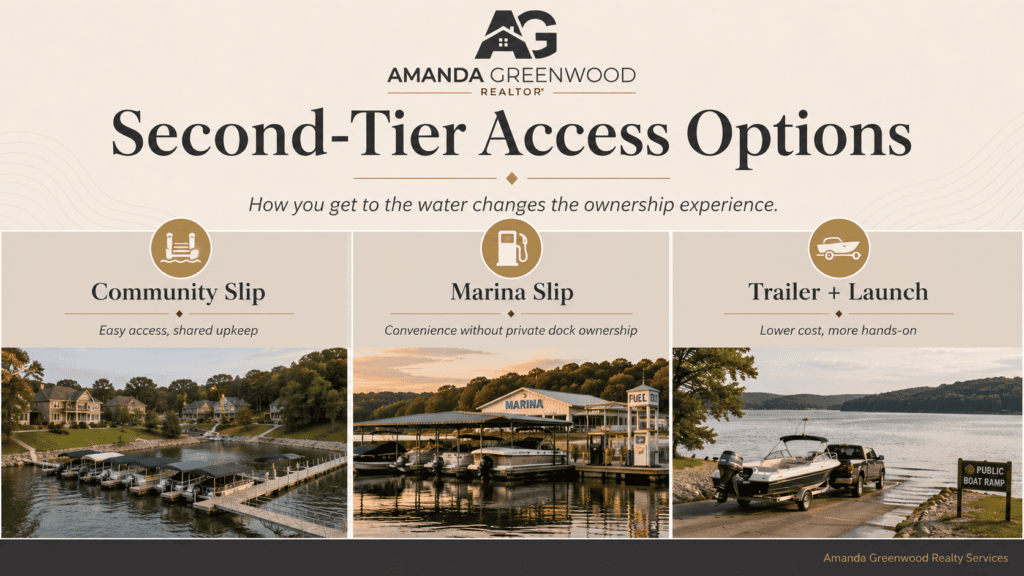
A second-tier owner may avoid most of those private shoreline responsibilities and still have excellent boating access through a community dock. Or they may need to rent a marina slip, store the boat somewhere else, or trailer it to a launch every time they want to use it.
That’s why I don’t think the first question should be:
“Can I afford lakefront?”
I think the better question is:
“How do I actually plan to use Lake of the Ozarks, and which type of property makes that lifestyle easiest to own?”
What Does “Second-Tier” Actually Mean at Lake of the Ozarks?
This is one of the first things buyers need to understand.
“Second-tier” is commonly used in Lake of the Ozarks real estate to describe property that’s close to the lake but doesn’t have its own direct shoreline frontage.
But the term itself doesn’t tell you what kind of lake access comes with the home.
A second-tier property might have:
- An assigned or otherwise controlled boat slip in a community dock
- Access to a subdivision dock
- A community boat ramp
- Trailer parking
- Common lake access
- A year-round or seasonal lake view
- Several of those features together
Another second-tier home may have a beautiful lake view and absolutely no boating access tied to the property.
That distinction matters a lot.
If I’m evaluating a second-tier property with a buyer, I want to know exactly what comes with it.
Not just, “It has lake access.”
I want to know:
- Is a boat slip included?
- Which exact slip?
- What size is it?
- Will the buyer’s current boat fit?
- How is the right to use that slip established?
- Does it transfer with the property?
- Is a boat lift included?
- Who owns the lift?
- Who maintains the community dock?
- What fees are charged?
- Can owners be assessed for repairs?
- Is there a community boat ramp?
- Is trailer parking allowed?
- How far is the home from the dock?
Two homes described as second-tier can give you completely different Lake of the Ozarks lifestyles.
What Are You Really Paying for With Lakefront?
The obvious advantage of lakefront is immediate access.
For a lot of buyers, that’s worth a significant premium.
Picture waking up on a Saturday morning, carrying your coffee down to your own dock, and deciding ten minutes later to take the boat out.
There’s no driving to the marina.
No hooking up a trailer.
No waiting at a launch.
No loading everything into the car first.
You just walk from your house to the water.
Depending on the property, lakefront ownership can let you:
- Keep your boat directly behind your home
- Swim from your own property
- Fish from your dock
- Sit on the dock even when you’re not boating
- Load groceries, coolers, and gear directly from the house
- Take short, spontaneous boat trips
- Entertain between the home, deck, shoreline, and dock
- Return by boat and immediately be home
If boating and waterfront living are the main reasons you’re buying at Lake of the Ozarks, that convenience can be hard to beat.
But you’re not just buying convenience.
You’re also taking ownership of more infrastructure.
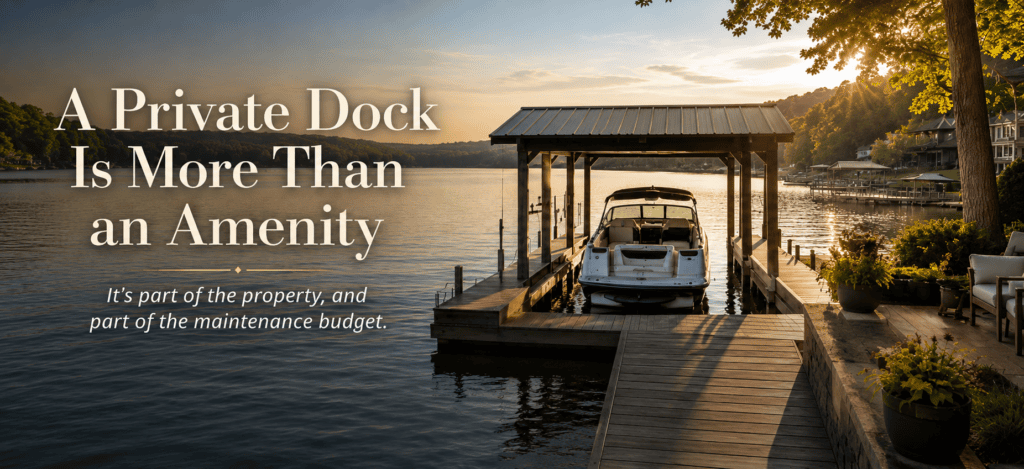
A Private Dock Isn’t Just an Amenity
One mistake I don’t want a Lake of the Ozarks buyer making is treating the dock like patio furniture.
A substantial dock can be one of the more valuable improvements attached to a lakefront property.
It can also become one of the more expensive things to repair or replace.
At Lake of the Ozarks, docks require Ameren Missouri permitting before placement. Ameren also has procedures that apply when lakefront property ownership changes.
So when we look at a lakefront property, I want to investigate more than whether the dock looks great in the listing photos.
I want to know:
- Is the dock permitted?
- Does the existing dock appear to match the permit?
- What size are the slips?
- Will those slips fit the buyer’s boat?
- What lifts are included in the sale?
- What condition are those lifts in?
- What type of decking is installed?
- What condition are the floats in?
- What condition is the roof?
- What condition are the cables, anchors, and structural components in?
- What’s the condition of the electrical system?
- Has the electrical system been properly inspected?
- What’s the water depth beneath the slips?
- Will the dock still work if the buyer wants a larger boat later?
That’s not overkill.
If you’re paying a premium for lakefront partly because of the dock, the dock deserves real due diligence.
Lakefront Ownership Also Means Looking at the Shoreline
The dock gets most of the attention, but the shoreline can matter just as much.
A lakefront property may include responsibility for:
- Seawall
- Riprap
- Shoreline stabilization
- Erosion
- Retaining structures
- Steps to the dock
- Drainage
- Lake-water pumps
- Piers
- Shoreline vegetation
- Trees near the water
Ameren Missouri manages shoreline development around Lake of the Ozarks, and proposed shoreline improvements such as docks, seawalls, piers, pumps, and other structures can require permitting before construction.
So if I’m looking at a beautiful lakefront house and the seawall is showing significant deterioration or the shoreline has obvious erosion, I’m not treating that like a minor landscaping issue.
It’s part of the ownership picture.
The shoreline deserves attention just like the roof, HVAC, foundation, or septic system.
Water Depth Deserves More Than a Quick Look
A buyer can visit a home in midsummer, see plenty of water under the dock, and assume water depth will never be an issue.
I’m not comfortable making that call from one showing.
Lake levels at Lake of the Ozarks fluctuate, and Ameren manages Bagnell Dam and shoreline operations.
For a serious boating buyer, I want to think about:
- Water depth at the dock
- Water depth inside the slip
- Cove depth
- Boat draft
- Seasonal lake-level changes
- Position of the dock within the cove
- Whether the buyer may want a larger boat later
A smaller runabout and a large cruiser can have very different requirements.
“Lakefront” by itself doesn’t answer that question.
Where Second-Tier Can Get Really Attractive
Now take away the private shoreline.
Depending on the property, a second-tier owner may avoid personally maintaining:
- A private seawall
- Private shoreline stabilization
- A complete private dock
- Dock roof
- Dock flotation
- Dock anchoring
- Private dock electrical infrastructure
- Multiple boat lifts
- Direct shoreline erosion
That can make ownership a lot simpler.
But boating doesn’t suddenly become free.
The cost just shifts somewhere else.
A second-tier buyer may pay for:
- HOA dues
- Community dock fees
- Dock assessments
- Marina slip rent
- Boat storage
- Trailer storage
- Boat launch fees
- Boat lift expenses
- Additional vehicle and fuel costs for trailering
That’s why I don’t describe second-tier as simply the “cheaper version” of lakefront.
It’s a different ownership model.
Second-Tier With a Community Slip Can Be a Sweet Spot
For the right buyer, this can be one of the most attractive combinations at Lake of the Ozarks.
Imagine buying a second-tier home that gives you:
- A good lake view
- An included boat slip
- A community dock
- Reasonable HOA or dock fees
- A nearby community boat ramp
- Trailer storage
- A short drive, walk, or golf-cart ride to the dock
That buyer may get a large percentage of the boating lifestyle while avoiding the responsibility of maintaining an entire private shoreline and dock.
But I still want details.
If the MLS says community dock with slip, I want to know:
- Which slip?
- What size?
- What boat size will it fit?
- Is a lift included?
- Who owns that lift?
- How is the slip assigned?
- Does that arrangement transfer with the house?
- Who maintains the dock?
- Who pays the electrical costs?
- How are major repairs funded?
- Can the association issue special assessments?
- Is there reserve funding?
- How far is the dock from the house?
- Is there parking near the dock?
- Is there a community ramp?
- Is boat and trailer storage permitted?
A community slip that’s a two-minute golf-cart ride away is a very different experience from one that requires getting in the car and driving across the subdivision.
Both may show up in marketing as “lake access.”
They’re not the same thing.
Second-Tier With a Marina Can Work Really Well Too
Some buyers don’t need a community dock at all.
They buy the home they like and keep the boat at a commercial marina.
Lake of the Ozarks has marina options that offer wet slips and other boating services. For some owners, that can be a really good arrangement.
You pay for the slip, but you’re not personally responsible for maintaining the entire dock infrastructure.
The biggest question becomes location.
A second-tier home that’s five or ten minutes from the marina where your boat is stored may feel very convenient.
A home that’s 25 or 30 minutes away may feel completely different.
That’s why I’d rather investigate realistic marina options while we’re comparing homes than buy the house and assume we’ll figure out boat storage afterward.
The right slip size may not be available exactly where you want it.
Second-Tier With a Trailer Changes the Lifestyle Again
The lowest-infrastructure option may be keeping the boat on a trailer and launching when you want to use it.
That can absolutely work.
But the launch fee itself isn’t the big issue.
The real issue is convenience.
A trailering owner needs to think about:
- Where the boat will be stored
- Where the trailer will be stored
- Whether the HOA allows boat and trailer parking
- Whether the driveway is large enough
- Whether the driveway grade works for a trailer
- Whether the owner has the right tow vehicle
- Trailer tires
- Wheel bearings
- Registration
- Maintenance
- Fuel while towing
- Distance to the nearest practical ramp
- Parking after launching
- Ramp congestion
There’s a big difference between walking to your private dock and hooking up a trailer every time you want to use the water.
Some buyers are completely fine with that trade.
Others quickly realize they boat less because launching becomes an event.
Neither buyer is wrong.
They just need different properties.
Lakefront vs Second-Tier: The Biggest Difference May Be Convenience
This is where a spreadsheet stops telling the whole story.
Picture four owners at 6:00 on a beautiful Friday evening.
Owner One: Lakefront
They walk downstairs.
They uncover the boat.
They leave.
Owner Two: Second-Tier With a Nearby Community Slip
They grab their things, hop in the golf cart or car, drive a couple of minutes to the dock, and leave.
Owner Three: Second-Tier With a Marina Slip
They load the car, drive to the marina, park, unload, and leave.
Owner Four: Second-Tier With a Trailer
They hook up the trailer, load the gear, tow the boat to the ramp, launch, park the truck and trailer, and then leave.
All four people have access to Lake of the Ozarks.
But they don’t have the same boating experience.
That matters because convenience often affects how frequently people actually use the lake.
A buyer who thinks they’ll boat four days a week may feel very differently about trailering than a buyer who plans to boat twice a month.
Lakefront May Be Worth the Premium When…
I’d take lakefront very seriously when a buyer tells me:
- “The water is the main reason we’re buying.”
- “We plan to boat constantly.”
- “I want my boat directly behind the house.”
- “I want to sit on my own dock even when we aren’t boating.”
- “I want to swim or fish from the property.”
- “I don’t want to load the car to get to the boat.”
- “We entertain on the water a lot.”
In that situation, the additional purchase price and waterfront maintenance may be buying something they’ll appreciate almost every day.
Second-Tier With a Community Slip May Be Better When…
This option gets especially interesting when the buyer says:
- “I want easy boat access, but I don’t care whether the dock is directly behind the house.”
- “I’d rather spend more of my budget on the house.”
- “I don’t want to maintain my own seawall.”
- “I don’t want responsibility for an entire dock.”
- “A short golf-cart ride to the boat doesn’t bother me.”
- “The HOA and community dock are well maintained.”
For that buyer, the right second-tier property may offer a really attractive balance.
Second-Tier With Marina Storage May Be Better When…
I’d consider this arrangement when the buyer wants:
- A lower-maintenance property
- Professional marina services
- Less responsibility for dock infrastructure
- A home in a neighborhood where no community slips are available
- Boating access without owning private shoreline
The recurring marina cost still needs to be part of the budget, but it may make more sense than buying and maintaining private waterfront.
Second-Tier With Trailering May Be Better When…
This can make sense when the buyer:
- Boats occasionally
- Already owns a good tow vehicle
- Is comfortable launching and retrieving
- Has practical boat and trailer storage
- Would rather put more money into the house itself
- Doesn’t place a high value on spontaneous boating
Again, the important word is occasionally.
If someone wants to boat constantly, repeated launching and retrieving may get old pretty fast.
Don’t Compare Purchase Prices Until You Compare the Boating Plans
This is one of the biggest mistakes I think a buyer can make.
Let’s say you’re comparing:
Home A: Lakefront with a private dock
and
Home B: Second-tier for quite a bit less money.
At first, Home B looks like the obvious value.
But now tell me how the boat will be handled.
Does Home B require:
- HOA dues?
- A marina slip?
- Boat storage?
- Trailer storage?
- A boat lift?
- A larger tow vehicle?
- A drive to the marina every time you boat?
Now let’s look at Home A.
Does the existing dock need:
- New decking?
- Electrical corrections?
- Lift replacement?
- Flotation work?
- Roof work?
- Structural repair?
How does the seawall look?
How’s the shoreline?
Until we answer those questions, we’re not comparing the actual cost of ownership.
We’re comparing two list prices.
The Lakefront vs Second-Tier Question Every Buyer Should Answer
Before choosing lakefront or second-tier, picture a completely ordinary Saturday after you’ve owned the property for two years.
Not vacation week.
Not the first weekend after closing.
Just a normal Saturday.
Where’s your boat?
How long does it take you to get from the kitchen to being underway?
Do you care?
Would you rather spend the extra money to put the water directly behind your house?
Or would you rather put that money into:
- A larger home
- A newer home
- A better view
- More bedrooms
- Better outdoor space
- A different location
- Lower maintenance
- Other parts of your Lake of the Ozarks lifestyle
That answer is far more useful than simply deciding that lakefront is automatically “better.”
My Lakefront vs. Second-Tier Comparison Checklist
If You’re Considering Lakefront
Before buying, I want to know:
- Is the dock properly permitted?
- Does the existing dock configuration match the permit?
- What condition is the dock in?
- What condition is the electrical system in?
- What lifts are included?
- What are the slip dimensions?
- Will the buyer’s boat fit?
- What’s the water depth?
- How does the cove function during lower lake levels?
- What condition is the seawall or shoreline stabilization in?
- Is there visible shoreline erosion?
- How difficult is the walk from the house to the dock?
- What waterfront maintenance is likely in the next few years?
If You’re Considering Second-Tier
Before buying, I want to know:
- Does the property actually include lake access?
- Is a boat slip included?
- What size is the slip?
- How is the slip assigned or controlled?
- Does that right transfer with the property?
- Is a boat lift included?
- Who maintains the community dock?
- What annual dock or HOA fees apply?
- Can owners face special assessments?
- Is there a community boat ramp?
- Can boats and trailers be stored at the property?
- If not, where will they be stored?
- What nearby marina options exist?
- How long will it realistically take to get from the house to the boat?
Those answers tell me a lot more about the property than the words lakefront or second-tier ever could.
Frequently Asked Questions About Lakefront vs Second-Tier at Lake of the Ozarks
Is lakefront or second-tier better at Lake of the Ozarks?
Neither is automatically better. Lakefront usually gives you the greatest boating convenience and direct control over your lake access, but you’ll also take on more dock and shoreline responsibility. Second-tier can offer a lower-maintenance ownership option, especially when the property includes a convenient community slip or has good marina access. The better choice depends on how often you’ll boat, how much convenience matters to you, and how much waterfront maintenance you want to own.
What is a second-tier home at Lake of the Ozarks?
A second-tier home generally refers to property located near Lake of the Ozarks without its own direct shoreline frontage. Some second-tier properties include community dock slips, boat ramps, or other lake access, while others may only offer a lake view. Buyers should verify the exact rights and amenities tied to the individual property.
Does a second-tier home automatically include lake access?
No. The term second-tier by itself doesn’t guarantee a boat slip, dock, ramp, or other lake-access rights.
Does a private dock at Lake of the Ozarks need a permit?
Yes. Ameren Missouri requires docks at Lake of the Ozarks to be permitted before placement.
Should the dock be investigated when buying lakefront property?
Absolutely. Buyers should look at the dock’s permit status, configuration, structure, electrical system, decking, flotation, roof, anchoring, lifts, slip dimensions, and water depth as part of their due diligence.
Is a community boat slip the same as owning a private dock?
No. A community slip can provide very convenient lake access, but you’re sharing dock infrastructure, maintenance procedures, rules, and potentially repair expenses with other owners or an association.
Can a second-tier owner keep a boat at a marina?
Yes. Lake of the Ozarks has commercial marina options offering wet-slip rentals and other boating services. Availability, slip size, cost, and distance from the home should all be verified before you rely on that option.
Can a second-tier owner use public boat launches?
Yes. Public boat launches are another option for second-tier owners, but you’ll want to consider trailer storage, launch distance, parking, and how often you realistically plan to boat.
Is lakefront always better than second-tier?
No. Lakefront can provide maximum convenience and direct control over lake access, but it also comes with more waterfront infrastructure and maintenance. A well-located second-tier property with a good community slip or nearby marina may be a better fit for someone who wants boating access without private shoreline responsibilities.
The Bottom Line
When you’re comparing lakefront vs second-tier at Lake of the Ozarks, don’t reduce the decision to purchase price alone.
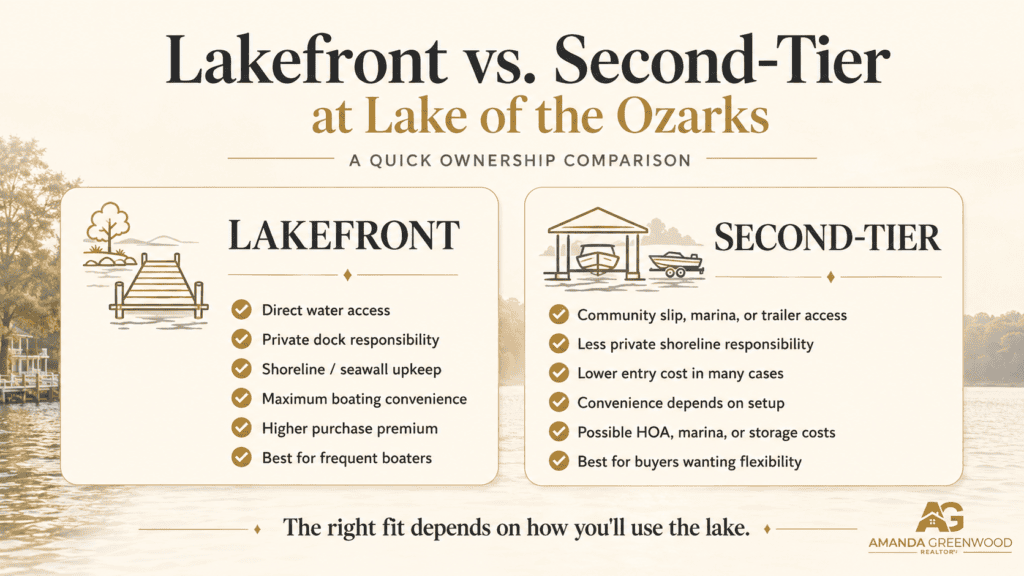
Lakefront typically gives you direct access, control, and maximum boating convenience, but it also comes with more waterfront infrastructure to maintain.
Second-tier can reduce private shoreline responsibility, but the quality of the boating experience depends heavily on whether you have a community slip, marina access, a nearby ramp, or a practical trailering setup.
You’re paying for direct access, control, and convenience, while also accepting responsibility for more waterfront infrastructure.
Buying second-tier isn’t simply choosing the cheaper alternative.
Depending on the property, you may be choosing a community dock, marina, boat ramp, or trailering setup that reduces your private shoreline responsibilities while changing how you access the water.
Neither option is automatically better.
The right answer depends on how often you plan to boat, where you want the boat stored, how much convenience matters to you, how much waterfront maintenance you want to own, and where you want your money invested.
At Amanda Greenwood Realty Services, I want buyers to understand those differences before they fall in love with the house, the view, or the dock.
Because at Lake of the Ozarks, finding the right home is only part of the decision.
You also need to choose the right way to live on the lake.

Protecting legacy. Building trust. One home at a time.

Amanda Greenwood
Missouri real estate agent serving Lake of the Ozarks, Fort Leonard Wood, Lebanon, and Central Missouri. Book a consultation →