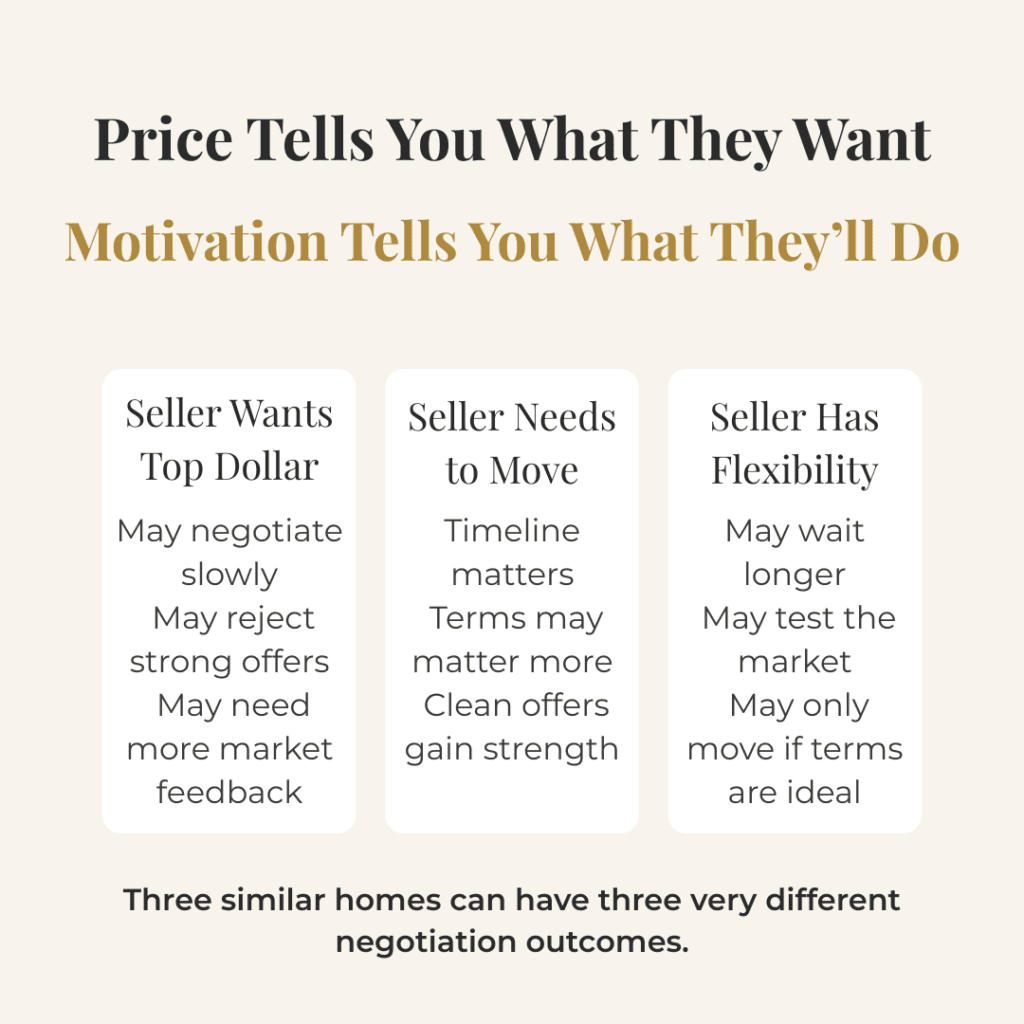
Some sellers are relocating. Some are downsizing. Some are managing an estate, a life change, or a financial decision. Others are simply testing the market to see what happens.
The challenge is that motivation is rarely listed on a property information sheet — yet it often plays a bigger role in negotiations than the asking price itself.
Why Motivation Matters
Two homes can be listed at exactly the same price and receive the same offer.
One seller may reject it immediately.
The other may accept within hours.
The difference often is not the house.
It is the motivation behind the person selling it.
Strategy Note: Motivation does not mean weakness. It means understanding what matters most to the other side. Price, timing, repairs, certainty, closing dates, possession, and financing can all become negotiating tools when motivation is properly understood. The better you understand motivation, the better you can protect leverage.
What Buyers Need to Protect
Buyers often focus on finding the right property.
The challenge is that excitement can sometimes weaken negotiating leverage.
A seller who believes a buyer has no alternatives may feel less pressure to negotiate on price, repairs, closing costs, or terms.
That does not mean playing games.
It means having representation that helps uncover seller motivation while protecting your own.
In today’s market of fluctuating interest rates, affordability concerns, and changing inventory levels, protecting leverage can be just as important as finding the right house.
What Sellers Need to Protect
Sellers face a different version of the same challenge.
The more a seller appears desperate to move, the more likely buyers are to push for concessions, repairs, credits, or price reductions.
That does not mean hiding legitimate circumstances.
It means creating a strategy that protects negotiating power throughout the listing process.
Pricing strategy, showing strategy, communication strategy, and offer evaluation all become part of protecting leverage.
A seller’s motivation should shape the plan—not weaken the position.
Why Representation Matters
Every negotiation has two stories.
What is being said.
And what is driving the decision behind it.
Strong representation helps identify motivation without exposing leverage.
Buyers deserve someone focused entirely on protecting their interests.
Sellers deserve someone focused entirely on protecting theirs.
When both sides are properly represented, negotiations tend to become clearer, smoother, and more productive.
Final Thoughts
In today’s market, buyers are watching interest rates.
Sellers are watching inventory levels.
Everyone is watching affordability.
Yet one of the most powerful factors in any negotiation often remains hidden.
Motivation.
Understanding motivation while protecting leverage can be the difference between a stressful transaction and a successful one.
The best outcomes rarely happen by accident.
They happen through preparation, strategy, and representation.
Ready to build a smarter buying or selling strategy?
Whether you’re buying, selling, or simply trying to understand your options, I’d be happy to help you create a strategy built around your goals, your timeline, and your leverage.